Prerequisite: This is Part 3 of the Production Agents Deep Dive series. Read Part 2: State Persistence first — HITL pauses depend on the checkpoint contract that lets a workflow wait days for a human without losing state.
Same agent, same high-stakes decision. Confidence routing + risk-based escalation + LangGraph interrupt turn an unauditable autonomous call into a documented human-gated one.
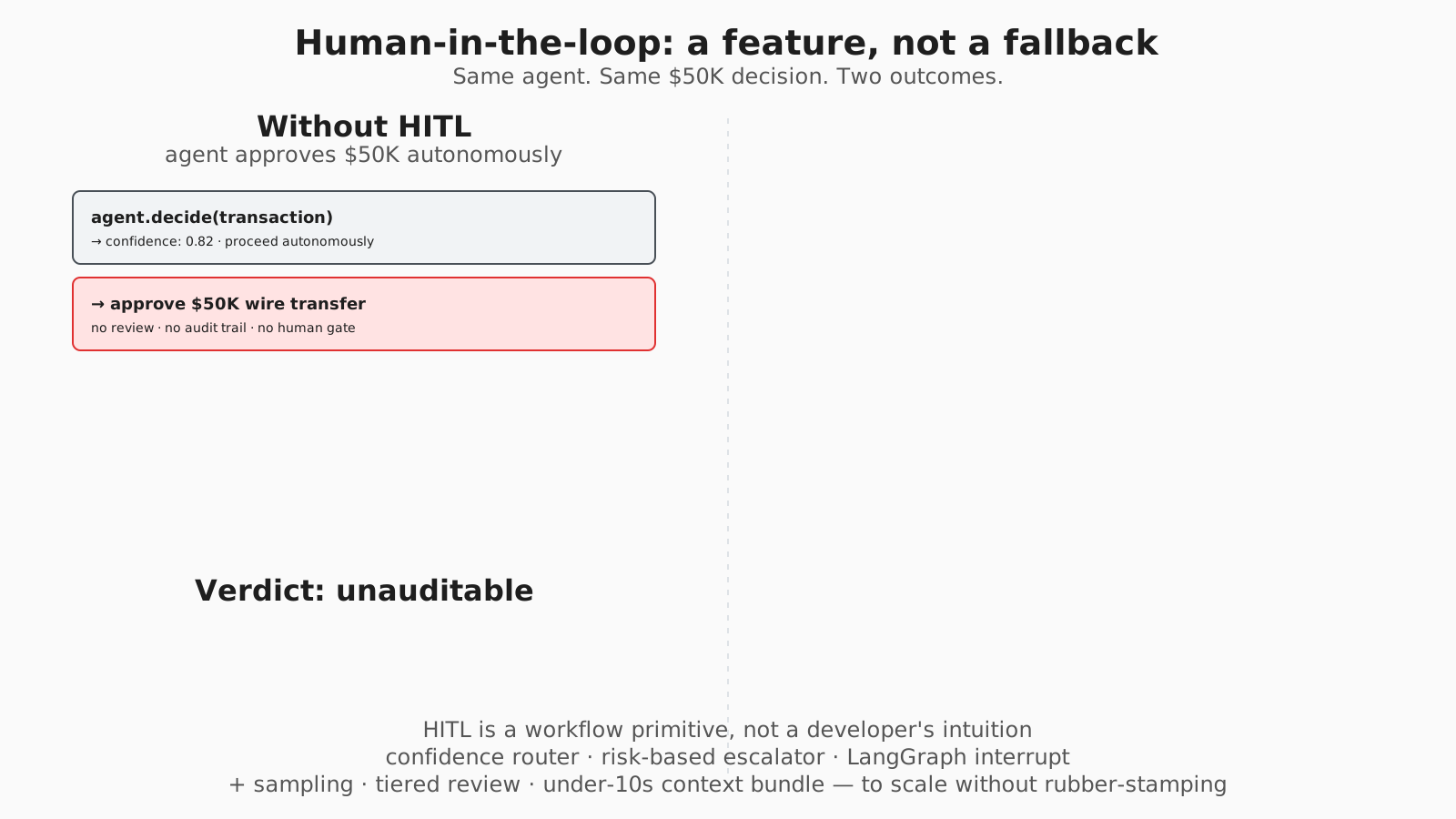
Human-in-the-loop: a feature, not a fallback
Why This Matters
Your agent makes a $50K decision. It’s wrong. No one reviewed it. The audit finds no human oversight existed.
Human-in-the-Loop (HITL) is not a fallback for immature agents. It’s a permanent production pattern for:
- Regulatory compliance — the EU AI Act explicitly requires it for high-risk systems [eu-ai-act-art14]
- Risk mitigation — high-stakes decisions need judgment the model cannot supply
- Quality — humans catch upsell opportunities, edge cases, and silent semantic failures that the agent’s confidence score cannot see
The distinction:
- Not: a fallback for when agents fail
- Is: a feature for when judgment is needed
What other content gets wrong: every LangGraph tutorial demonstrates interrupt() on the happy path. None of them show what happens when the human takes 36 hours to respond and your deployment cycle restarts the worker in the middle, or when the queue backs up and humans start rubber-stamping. This chapter pins the canonical from langgraph.types import interrupt API (the older langgraph.prebuilt import path is stale), spells out the EU AI Act Article 14 obligations operators actually need to meet, and names the operational decay mode — the “rubber-stamp slide from month 1 to month 9” — that no framework doc covers.
Takeaway: HITL is a permanent architectural feature, not a developer’s-first-draft safety net. Treat the human as a load-bearing participant whose decisions are recorded, audited, and constrained by the same SLAs as the agent’s.
What Goes Wrong Without This:
Symptom: Customer complaints about agent decisions nobody approved.
Cause:   Agent processed high-stakes requests autonomously.
       No escalation triggers for risky decisions.

Symptom: Audit failure, regulatory fine.
Cause: EU AI Act Article 14 requires human oversight for high-risk AI.
No documentation of human review capability.

Symptom: Silent failures causing business damage.
Cause: Agent completed task successfully (no errors).
But made semantically wrong decision (DELETE vs ARCHIVE).
Nobody caught it until customer complained.
Takeaway: every symptom here is a “missing human gate” failure. The gate isn’t optional UX — it’s where compliance, risk, and quality all converge.
Why HITL Is Better Business
There’s a temptation to frame HITL purely as a cost — humans are expensive, agents are cheap. The framing is wrong. HITL produces three measurable wins traditional automation misses:
- Edge-case capture — humans recognise unusual situations the agent has never seen and routes them correctly the first time, rather than retrying-then-failing
- Upsell + relationship moments — a human reviewer notices “this customer is one tier away from renewal” in ways no agent currently does
- Silent-failure interception — the only reliable catch for semantic failures (DELETE vs ARCHIVE, miscategorised intent) is a human who reads the output before it lands
The trade-off is operational: every HITL touchpoint costs reviewer time and latency. The pattern below is to escalate selectively — high-risk and low-confidence cases only — not to gate everything.
Takeaway: HITL adds cost in reviewer time and removes cost in support tickets, lost trust, and regulatory exposure. The net is almost always positive for high-stakes domains.
Regulatory Requirements
This isn’t optional in many domains.
EU AI Act Article 14 (Human Oversight, adopted 2024-06-13; provisions enter into force 2026-08-02) [eu-ai-act-art14] requires high-risk AI system operators to enable natural persons:
“to correctly interpret the high-risk AI system’s output, taking into account, for example, the interpretation tools and methods available” (Art 14(4)(c))
“to decide, in any particular situation, not to use the high-risk AI system or to otherwise disregard, override or reverse the output” (Art 14(4)(d))
“to intervene in the operation of the high-risk AI system or interrupt the system through a ‘stop’ button or a similar procedure” (Art 14(4)(e))
For biometric identification systems, Article 14(5) raises the bar to two-person verification — no deployer action on an identification “unless that identification has been separately verified and confirmed by at least two natural persons with the necessary competence, training and authority.”
NIST AI Risk Management Framework — Generative AI Profile (NIST AI 600-1) [nist-airmf] outlines management actions for GenAI risks including human oversight in high-impact deployments; consult the document directly for the actions that apply to your system.
Takeaway: regulatory HITL is not a feature you ship; it’s an obligation you discharge. Map your high-risk decisions to specific Article 14 paragraphs before deploy.
Pattern 1: Confidence-Based Routing
Route decisions based on how confident the agent is.
class ConfidenceRouter:
    def __init__(self, high_threshold=0.8, low_threshold=0.5):
        self.high = high_threshold
        self.low = low_threshold

    def route(self, decision):
        if decision.confidence >= self.high:
            return "autonomous"  # Complete without human
        elif decision.confidence >= self.low:
            return "review"       # Flag for human review
        else:
            return "escalate"     # Immediate human takeover

# In agent loop
decision = agent.think(state)
route = router.route(decision)

if route == "autonomous":
    result = agent.execute(decision)
elif route == "review":
    # Execute but queue for human review
    result = agent.execute(decision)
    queue_for_review(decision, result)
else:  # escalate
    result = await human.handle(state, decision)
Example: Invoice Processing
| Confidence | Scenario | Handling |
|---|---|---|
| >0.8 | Clean invoice, all fields present | Autonomous processing |
| 0.5-0.8 | Missing data, low OCR confidence | Execute + queue for review |
| <0.5 | Multiple validation failures, unusual amounts | Immediate human takeover |
Takeaway: confidence routing is the cheapest HITL pattern. Calibrate thresholds against override-rate data; if humans reverse >20% of “autonomous” decisions, the high threshold is too low.
Pattern 2: Risk-Based Escalation
Some decisions require humans regardless of confidence.
class RiskBasedEscalation:
    def should_escalate(self, decision, context):
        # High stakes? Always human.
        if decision.involves_payment and decision.amount > 500:
            return True, "high_value_transaction"

        # Low confidence? Ask human.
        if decision.confidence < 0.7:
            return True, "low_confidence"

        # Irreversible? Double-check.
        if not decision.reversible:
            return True, "irreversible_action"

        # Angry customer? Handoff.
        if context.sentiment_score < -0.6:
            return True, "negative_sentiment"

        # Regulatory domain? Human oversight.
        if decision.domain in ["legal", "medical", "financial"]:
            return True, "regulated_domain"

        return False, None
Risk Tiers
| Tier | Examples | Handling |
|---|---|---|
| Low (Autonomous) | FAQs, status lookups, basic troubleshooting | No escalation |
| Medium (Confidence-Based) | Account changes, refunds, config changes | Escalate if confidence < 0.7 |
| High (Always Human) | Legal issues, compensation, financial >$X, angry customers | Always escalate |
Takeaway: risk trumps confidence. A 0.95-confidence call for “delete production database” still needs a human; risk-based escalation is the rule that says so.
Pattern 3: LangGraph Interrupt
LangGraph provides native HITL support through the interrupt primitive — exported from langgraph.types (the older langgraph.prebuilt import path is stale) [langgraph-interrupt]:
from langgraph.types import interrupt, Command

def approval_gate(state):
    """Pause for human approval before proceeding."""
    decision = state["pending_decision"]

    if needs_approval(decision):
        # Pause execution; LangGraph checkpoints state at this point.
        # On resume, the client passes the human's input via Command(resume=...).
        human_input = interrupt({
            "question": f"Approve this action? {decision.description}",
            "options": ["approve", "reject", "modify"],
        })

        if human_input["choice"] == "reject":
            return {"status": "rejected", "reason": human_input.get("reason")}
        if human_input["choice"] == "modify":
            return {"decision": human_input["modified_decision"]}

    return {"status": "approved"}

# Resume the graph after the human responds:
# graph.invoke(Command(resume={"choice": "approve"}), config={"thread_id": ...})
Key capabilities:
- Approval gates: deploy, purchase, delete
- Correction opportunities: review draft, edit action before sending
- Safety checks: validate before irreversible actions
Why this works: the checkpointer (Ch02) preserves exact state at the interrupt() call. The human can take hours, days, or weeks to respond. When Command(resume=...) is supplied via graph.invoke, execution resumes from the exact point — variables, accumulated context, and pending actions intact.
Takeaway: interrupt() is HITL as a workflow primitive, not an API call. The cost of getting it wrong is losing checkpoint state across a redeploy — pin a durable checkpointer (PostgresSaver, not MemorySaver) before relying on it.
Pattern 4: Predictive Escalation
Don’t wait for problems. Predict them.
class PredictiveEscalator:
    def __init__(self, model):
        self.model = model  # ML model trained on escalation history

    def should_preemptively_escalate(self, context):
        features = {
            "customer_history": context.customer.escalation_rate,
            "transaction_type": context.transaction.type,
            "time_of_day": context.timestamp.hour,
            "message_length": len(context.latest_message),
            "sentiment_trajectory": context.sentiment_delta,
        }

        probability = self.model.predict_proba(features)

        if probability > 0.7:
            # Prepare human agent BEFORE failure
            return PreemptiveEscalation(
                probability=probability,
                prepared_context=self.prepare_context(context)
            )

return NoneBenefits:
- Human agent prepares in advance (review history, load context)
- Seamless transition when escalation triggers
- No wait time for context loading
Takeaway: predictive escalation works only when you have escalation-history training data. Don’t ship predictive routing on day zero — collect baseline data first, then turn it on.
The Scaling Problem
This is the biggest HITL gotcha.
Month 1:  Works great. Humans approve/reject, agents learn.
Month 3:  Humans overwhelmed. Approval queue 4 hours deep.
Month 6:  Humans approve everything without reading. Rubber-stamp.
Month 9:  Fraud incident. Human "approved" $50K transfer from 200-item queue.
The problem: Human escalation doesn’t scale linearly. As agent volume grows, human bandwidth doesn’t.
Solutions
1. Sampling instead of 100% review
def should_review(decision):
    if decision.is_high_risk:
        return True  # Always review high-risk
    # Review random 10% of medium-risk
    return decision.is_medium_risk and random.random() < 0.10
2. Tiered review
escalation_routing = {
    "routine": "junior_reviewer",      # Basic account changes
    "medium_risk": "senior_reviewer",  # Refunds, policy exceptions
    "high_risk": "manager",            # Large transactions, legal
}
3. Batch review
# Group similar decisions for efficient processing
batches = group_by(pending_decisions, key="decision_type")
for decision_type, decisions in batches.items():
    reviewer = get_reviewer_for_type(decision_type)
    reviewer.review_batch(decisions)
4. Automation feedback loop
def learn_from_human_decision(decision, human_override):
    if human_override:
        # Human disagreed with agent
        log_training_example(decision, human_override.choice)
# Retrain periodically to improve confidence calibrationTakeaway: the rubber-stamp slide is the HITL bug that hurts most. Sampling, tiered review, and batch processing are not nice-to-haves — they’re the difference between HITL that scales and HITL that decays into theatre.
Production Metrics
Track these to know if your HITL system is healthy:
| Metric | What It Measures | Target |
|---|---|---|
| Escalation Rate | % of tasks escalated to humans | 10-30% (domain-dependent) |
| Escalation Precision | % of escalations that actually needed human | >80% |
| Escalation Recall | % of problems that got escalated | >95% |
| Time-to-Escalate | Latency from trigger to human notification | <10 seconds |
| Override Frequency | How often humans override agent decisions | Monitor for trends |
| Time-to-Correct | Human time spent fixing agent errors | Minimize |
| Task Success Rate | % completed correctly (with or without human) | >95% |
| Cost per Resolution | Agent cost + human time cost | Track for ROI |
Warning Signs
| Metric | Warning | Investigation |
|---|---|---|
| Escalation Rate >40% | Agent too cautious | Review confidence thresholds |
| Escalation Rate <5% | Agent too aggressive | Check for silent failures |
| Override Rate increasing | Agent performance degrading | Review recent changes, retrain |
| Time-to-Escalate >60s | System bottleneck | Optimize notification pipeline |
| Queue depth growing | Humans overwhelmed | Add staff or implement sampling |
Takeaway: escalation rate is the canary metric. Out-of-band in either direction (too high or too low) signals a calibration problem before any customer ever sees it.
Framework Comparison
| Framework | HITL primitive | Key property |
|---|---|---|
| LangGraph | interrupt() (from langgraph.types) + Command(resume=...) | Checkpointer-backed state preservation; clean resume across redeploys when using a durable checkpointer |
| Temporal | @workflow.signal methods + workflow.wait_condition | Multi-language SDK; built for hours-to-weeks-long human waits |
| AWS Step Functions | .waitForTaskToken + SendTaskSuccess/Failure | One-year execution lifetime; queue-driven human callbacks via SQS |
| Azure Durable Functions | context.wait_for_external_event | Idle-billing-friendly on Consumption Plan; at-least-once delivery semantics |
| Restate | ctx.awakeable<T>() | Lightweight typed handle; resolve externally via SDK client |
Takeaway: the HITL primitive choice almost always follows from the durable-execution framework choice. Pick the framework first (Ch06), inherit the HITL primitive.
Context Transfer Checklist
When escalating, humans need context fast. Include:
escalation_context = {
    # What happened
    "conversation_history": last_n_turns(10),
    "actions_attempted": agent.action_history,
    "failure_reason": agent.last_error or "low confidence",

    # What the agent was trying to do
    "current_goal": agent.current_task.description,
    "pending_decision": agent.pending_action,

    # Relevant data
    "customer_info": customer.profile,
    "transaction_details": transaction.summary,
    "policy_context": relevant_policies(transaction),

    # Recommendations
    "agent_recommendation": agent.preferred_action,
    "confidence": agent.confidence,
    "alternatives": agent.considered_alternatives,
}Target: Human should understand situation in under 10 seconds.
Takeaway: under-10-second context load isn’t a UX preference — it’s the difference between a reviewer who reads and a reviewer who rubber-stamps.
What to Copy, What to Skip
| Pattern | Copy when | Skip when |
|---|---|---|
| Confidence-based routing | Every production agent with side effects | Day-zero deployments without calibrated confidence scores |
| Risk-based escalation (always-human for high stakes) | Regulated domains (legal, medical, financial) and irreversible actions | Demos and read-only workloads |
LangGraph interrupt() from langgraph.types | LangGraph-based agents (use durable checkpointer to survive redeploys) | Older code using langgraph.prebuilt — update the import |
| Predictive escalation | Mature agents with ≥3 months of escalation-history data | Day-zero — no training data exists yet |
| Sampling (10% of medium-risk reviews) | High-volume workloads where 100% review would saturate humans | Audit-mandated 100%-review domains |
| Tiered reviewers | Diverse decision types — junior vs senior vs manager | Single-decision-type queues |
| Batch review | Bulk decisions where similar context applies | Time-sensitive individual decisions |
| Two-person verification | Biometric ID per EU AI Act 14(5); high-irreversibility decisions | Routine medium-risk decisions — overhead exceeds benefit |
| Under-10-second context bundle | Every escalation. No exceptions. | n/a — always include |
Takeaway: every pattern has a “skip when”. The under-10-second context bundle is the one row with no skip — it’s what prevents rubber-stamping in practice.
The HITL Checklist
Before deploying an agent with human escalation:
ESCALATION TRIGGERS
[ ] Confidence thresholds defined and calibrated
[ ] High-risk actions always escalate
[ ] Irreversible actions require confirmation
[ ] Regulatory requirements mapped to triggers

CONTEXT TRANSFER
[ ] Full conversation history preserved
[ ] Action history and outcomes included
[ ] Agent's recommendation and confidence visible
[ ] Under 10 second context load time

SCALING STRATEGY
[ ] Sampling strategy for high-volume scenarios
[ ] Tiered review structure
[ ] Queue depth monitoring and alerts
[ ] Feedback loop to improve agent over time

METRICS
[ ] Escalation rate tracked
[ ] Precision and recall measured
[ ] Time-to-escalate monitored
[ ] Override frequency analyzed
Takeaway: ship none of these and the next compliance audit finds no documented oversight. Ship all four blocks and HITL becomes auditable, scalable, and resilient to the rubber-stamp slide.
Closing
HITL is a workflow primitive, not a developer’s intuition. Confidence routing picks who can act autonomously; risk-based escalation overrides confidence when stakes demand it; interrupt() (from langgraph.types) checkpoints the workflow while waiting; tiered + sampled review keeps the human side scalable. The next chapter shows where most of those costs go — token spend — and how to bound it without losing the HITL safety net.
Testable question: for your last 100 high-risk decisions, can you produce the exact human reviewer, timestamp, and recorded rationale? If not, the HITL layer is theatre.
→ Part 4: Cost Control & Token Budgets — keeping the bill predictable while the humans-in-the-loop add up.
References
- [eu-ai-act-art14] European Parliament & Council — EU AI Act, Article 14 (Human Oversight). Adopted 2024-06-13; provisions enter into force 2026-08-02. artificialintelligenceact.eu/article/14. Source for the specific 14(4)(c)(d)(e) operator obligations (interpret, override/reverse, intervene/stop) and the 14(5) two-person verification rule for biometric identification.
- [nist-airmf] National Institute of Standards and Technology — AI Risk Management Framework: Generative AI Profile (NIST AI 600-1). nist.gov/itl/ai-risk-management-framework. Source for management actions on human oversight in GenAI deployments; consult the document directly for action items mapped to your system class.
- [langgraph-interrupt] LangChain — LangGraph: Human-in-the-Loop with
interrupt. langchain-ai.github.io/langgraph/how-tos/human_in_the_loop. Source for the canonicalfrom langgraph.types import interrupt, Commandimport path and theCommand(resume=...)resume pattern. - [pa-state] Production Agents — Part 2: State Persistence & Checkpointing. The durable-checkpointer requirement that makes
interrupt()survive across redeploys. - [pa-durable] Production Agents — Part 6: Durable Execution. Framework-by-framework HITL primitives (Temporal signals, AWS task tokens, Azure external events, Restate awakeables).