The New Rules of Shipping in the AI Era
This is for first-time founders building from zero. No platform experience. No GTM playbook. Just a problem you want to solve. If you’ve scaled before, some steps might compress. First time? They won’t.
Every Platform Started as a Feature
Slack was the internal chat tool for a failed game. AWS was Amazon’s internal infrastructure. Stripe was a YC side project. Shopify was a snowboard store’s custom software.
None of them planned to become platforms. They earned it.
Feature → Product → Platform. This is the evolution. It can be accelerated. It cannot be skipped.
The Evolution
This isn’t a framework. It’s physics. You can’t skip steps any more than you can skip adolescence.
Phase 1: Feature → Product
Feature to Product isn’t one jump. It’s a progression:
Each step has its own gate:
| Stage | You Do | Signal to Move |
|---|---|---|
| Feature | Build for yourself | It works, you use it daily |
| Reuse | Someone else uses it (copy, binary, utility) | 3+ people ask “can I use this?” |
| Library | Add docs, tests, package it | People use it without asking you |
| Service | Run it, expose API | Uptime matters, SLA requests |
| Product | Roadmap, versioning, support | Feature requests > bug reports |
Most features die at Reuse. That’s fine. Not everything should be a product.
The Origin Stories
Slack was the internal chat tool for Tiny Speck, a game company building Glitch. The game failed. The chat tool had 8,000 daily users on day one of public launch. It went Feature → Reuse → Product fast because the signal was overwhelming.
AWS was Amazon’s internal infrastructure. It went Feature → Reuse → Service slowly over years. The “can we use your servers?” signal kept getting louder until they couldn’t ignore it.
Stripe was a YC batch project. Feature → Library → Product. The Collisons literally installed it for people — hands-on validation at every step.
Shopify was a snowboard store’s custom software. Feature → Reuse → Service → Product. Other merchants asking “can I use your software?” was the signal at each gate.
None of them skipped steps. They earned each transition.
The Product Worthiness Test
You built something for yourself. Should it become a product?
Here’s the test I use. It’s five questions. Be honest.
Real Example: A Session Capturer
I built a tool to capture and analyze my Claude Code sessions. Session files get deleted after 30 days. I wanted to keep them, search them, learn from them.
Let me run the test honestly:
| Test | Question | My Answer | Pass? |
|---|---|---|---|
| Pain Frequency | How often? | Every session, daily | ✓ |
| Workaround Cost | What before? | Manual JSONL parsing, lost history | ✓ |
| Rebuild Test | Would I rebuild? | Yes — no alternative exists | ✓ |
| Name Three Users | Who else? | Power users in Discord complaining about retention | ✓ |
| Embarrassment Test | Show others? | Built a desktop app, so yes | ✓ |
Score: 5/5. Product candidate.
But here’s the critical distinction:
“Claude Code users” = too vague. Not a signal.
“Power users who run 5+ sessions/day and lose history after 30 days” = specific. That’s a signal.
“Those 3 people in Discord who complained about session retention last week” = names. That’s a strong signal.
The difference between “I should productize this” and “I’m the only weirdo” is whether you can name the users.
Signals: Your Feature Wants to Be a Product
| Signal | What It Looks Like | What It Means |
|---|---|---|
| The “Can I Use” Question | 3+ people ask to use your internal tool | Your feature solves a real problem |
| The Fork | Someone copies your code to their repo | Interface is wrong, value is right |
| The Wrapper | Someone builds an abstraction around you | They need you, but not like this |
| The Feature Overtakes | Your feature has more users than the parent | The tail is wagging the dog |
| The Support Flip | Questions about the feature > questions about the parent | You’re maintaining two products |
Feature → Product Deaths
The Premature Product: You extract your feature before anyone uses it. Result: a solution seeking a problem. You optimized for hypothetical users.
The Zombie Feature: You see the signals but ignore them. The feature stays embedded. It accumulates tech debt. Three people fork it. Now you have four incompatible versions, none of them owned.
The Overextraction: You extract too much. The feature worked because it was tightly coupled to its parent. Now it’s “flexible” and “configurable” and nobody knows how to use it.
The Loop at Feature Stage
At feature stage, the learning loop is tight and fast:
- SHIP: Build for yourself. Hours, not months.
- OBSERVE: Use it daily. Notice where it breaks.
- INTERPRET: “Is this just my problem, or is it real?”
- DECIDE: Fix it, expand it, or kill it.
Loop fast. Most features should die here. That’s the point.
What To Do at Feature Stage
- Run the Product Worthiness Test. Score yourself honestly.
- Validate with names. “Who would use this?” must have specific answers. No names = no product.
- Extract the minimum. Don’t build a “platform.” Build the smallest possible standalone thing.
- Keep one customer. Your first user is yourself. Don’t break that.
Phase 2: Product → Platform
When Product Becomes Platform
You’ve extracted the feature. It’s a product now. People use it. It has an API, maybe some docs. Life is good.
Then:
- Three people build wrappers around your tool
- Two more ask for webhooks or plugins
- Your support queue is 60% “how do I integrate with X?”
- New users spend 2+ weeks just figuring out how to extend it
You’re still calling yourself a product.
You’re already a platform. You just don’t know it yet.
Signals: Your Product Wants to Be a Platform
| Signal | Threshold | Meaning |
|---|---|---|
| Copy-paste infections | Same code in 3+ repos | Your interface is wrong |
| Support ratio flip | Integration Qs > feature requests | Integration IS your product |
| Integration tax | >2 weeks to onboard | Adoption is blocked by complexity |
| Wrapper explosion | Users build abstractions over you | They need stability you don’t provide |
| The “build vs. use” debate | Users consider building their own | You’re not worth the dependency |
The Platform Pressure Test
Forget complex formulas. Answer these questions:
Product → Platform Deaths
The Boiling Frog: Support load increases 10% per quarter. You keep prioritizing features over platform concerns. Engineers burn out. By the time you admit it, the debt is insurmountable.
The Premature Platform: “We’re building for scale” with 3 current users. 18 months later, beautiful architecture, zero new adoption. (The opening story.)
The Resume-Driven Platform: Kubernetes + Kafka + event sourcing + CQRS for what is, ultimately, a CRUD app. The complexity creates a 6-month learning curve. When the architects leave, the platform becomes unmaintainable.
The Loop at Product Stage
The loop slows down. The stakes are higher.
- SHIP: Release features, but also docs, SDKs, examples.
- OBSERVE: Watch support queues. Count integration questions. Track wrapper proliferation.
- INTERPRET: “Are they building ON us or AROUND us?”
- DECIDE: Invest in DX? Define contracts? Acknowledge platform pressure?
At product stage, OBSERVE and INTERPRET matter more than SHIP. You’re no longer validating “does it work?” You’re validating “should others depend on this?”
What To Do at Product Stage
- Acknowledge the transition. Say it out loud: “We are becoming a platform.”
- Define contracts. API versioning. SLAs. Deprecation policies. Write them down.
- Change your metrics. Measure time-to-first-integration and user NPS, not features shipped.
- Staff accordingly. You need developer experience people, not just engineers.
Phase 3: Platform
What Platform Actually Means
At platform stage:
- Others build ON you, not just WITH you
- Your stability is others’ foundation
- Your roadmap is no longer fully yours
- Your API is a contract, not an implementation detail
- Breaking changes break other people’s products
The Platform Graveyard
The Loop at Platform Stage
The loop changes completely. SHIP becomes dangerous.
- SHIP: Every change is a potential breaking change. Ship carefully, communicate obsessively.
- OBSERVE: Monitor ecosystem health, not just your metrics. How are your consumers doing?
- INTERPRET: “Is the ecosystem thriving? Are integrations growing? Is trust intact?”
- DECIDE: What can we commit to for years? What must we deprecate? What do we owe our consumers?
At platform stage, DECIDE dominates. Your decisions compound across an ecosystem. One bad decision breaks other people’s products.
What To Do at Platform Stage
- Reorganize around it. Dedicated team with consumer-facing OKRs.
- Fund proportionally to usage. Your product is now “ease of integration.”
- Slow down. Platform stability > feature velocity. Every change is a potential breaking change.
- Communicate obsessively. Deprecation timelines. Migration guides. Changelog culture.
The Two Paths
Why AI Doesn’t Change This
AI compresses creation. You can generate a “platform architecture” in an afternoon. Beautiful diagrams. RFC documents. Service contracts. All the artifacts.
But AI doesn’t compress evolution.
You can’t AI-generate:
- The 3 people who forked your code (signal)
- The support queue that flipped to integration questions (signal)
- The wrapper someone built because your interface was wrong (signal)
- The trust that comes from not breaking things for 18 months (foundation)
The artifacts of a platform are compressible. The evolution is not.
This is one of the few things that remains stubbornly time-bound. You still have to ship the feature. Watch who uses it. Notice the signals. Earn the next phase.
AI makes it faster to build the wrong platform. It doesn’t help you build the right one.
What Changes for Builders
If the evolution can’t be skipped, but AI changes everything else — what actually changes?
What to Drop
Drop: Long planning cycles. You don’t need 3 months to write the RFC. Ship the feature. Get signal.
Drop: “Build for scale” upfront. AI lets you rewrite fast. Build for now. Refactor when you have users.
Drop: Perfectionism before launch. The first version will be wrong. That’s the point. You need the signal that tells you how it’s wrong.
Drop: Large teams early. One person with AI can ship what took a team. Stay small until signals force you to grow.
What to Keep
Keep: Talking to users. AI can’t tell you if the problem is real. Only users can.
Keep: Watching for signals. The fork. The wrapper. The support flip. These still matter. Maybe more.
Keep: Earning each phase. Feature → Product → Platform. Still sequential. Still earnable. Not skippable.
Keep: Saying no. AI makes it easy to build everything. The discipline is building the right thing.
How to Accelerate
The phases can’t be skipped. But they can be faster.
| Phase | Old Speed | AI Speed | What Changed |
|---|---|---|---|
| Feature → Signal | Months | Days | Ship faster, get feedback faster |
| Signal → Product | Weeks | Days | Extraction is cheap, iteration is cheap |
| Product → Platform | Months | Weeks | Docs, SDKs, examples — all compressible |
The bottleneck moves.
Old bottleneck: Building the thing. New bottleneck: Finding the signal. Interpreting it correctly. Deciding what to build next.
The Learning Loop
“Speed of learning” sounds like consultant-speak. Let me make it concrete.
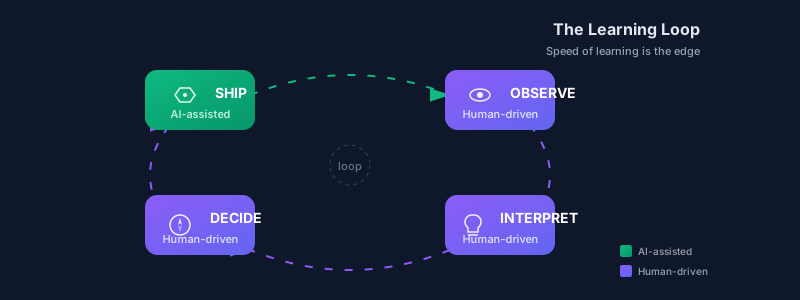
It’s a loop:
AI compresses SHIP. You can build in hours what took weeks. But OBSERVE, INTERPRET, DECIDE — that’s still you.
Fast learners complete this loop in days. Slow learners complete it in months.
Same AI. Same tools. Different speed.
Example: Building a Session Capturer
I’m building Tacit — a tool to capture and analyze Claude Code sessions. Here’s what fast vs slow looks like:
Week 1: SHIP
- Built CLI capturer in a weekend (AI-assisted)
- Basic: watch files, parse JSONL, store in SQLite
- Shipped to myself. Started using it.
Week 2: OBSERVE
- I kept opening session files manually to find “what did I do yesterday?”
- The CLI answered “what sessions exist” but not “what happened in them”
- Signal: I’m not using my own tool for its intended purpose
Week 2: INTERPRET
- The problem isn’t capture. It’s intelligence.
- I don’t want session files. I want session insights.
- “What tasks did I complete? What errors did I hit? What files changed?”
Week 2: DECIDE
- Build intelligence extraction. Tasks, errors, file evolution, time phases.
- Skip the “platform” temptation. No plugins. No API. Just solve my problem.
Week 3: SHIP (again)
- Built
pkg/intelligence/— extracts structured metrics from sessions - Built desktop app to surface it
- Started using it daily
Week 4: OBSERVE (again)
- Now I see: “15 tasks, 7 errors, 32 minutes, 47% implementation time”
- New signal: I want to compare sessions. “Am I getting faster? Making fewer errors?”
- New signal: Others in Discord asking about session retention
Loop continues.
Total time: 4 weeks, 4 loops.
A slow learner would:
- Spend month 1 planning the “architecture”
- Spend month 2 building capture + intelligence + analytics + API
- Spend month 3 in staging, not using it themselves
- Launch month 4 to… silence. Wrong thing, built perfectly.
The difference isn’t talent. It’s loop speed.
How to Speed Up the Loop
| Step | Slow | Fast |
|---|---|---|
| SHIP | Wait until it’s ready | Ship when it works for you |
| OBSERVE | Check metrics monthly | Use it daily, notice friction |
| INTERPRET | Guess what users want | Ask “why am I not using this?” |
| DECIDE | Committee meetings | Decide in hours, not weeks |
The tactics:
- Ship to yourself first. You’re user zero. Your friction is signal.
- Daily usage, not weekly check-ins. Observe continuously.
- Ask “why” immediately. Don’t batch insights. Interpret in the moment.
- Decide alone, fast. Committees slow the loop. Decide, ship, learn.
Speed of shipping is table stakes. Speed of learning is the edge.
AI gives everyone fast shipping. The edge is how fast you complete the full loop — Ship, Observe, Interpret, Decide — and start again.
The One Sentence
You earn the right to be a platform by first being a really good product. You earn the right to be a product by first being a really useful feature.
AI can generate the code. It can’t generate the signals that tell you what to build.
What stage are you at? Run the tests. The signals are there if you look for them.